1 — Interpreted vs compiled
Compilation, JIT and warmup
A tale of two ships


Goals
- Understand what happens between source code and the processor.
- See type specialization (why Julia ≈ C).
- Learn to measure performance properly.
▶ Notebook (demo + solution): Interpreted vs compiled
⬅ Previous: 0 — Julia for Python users · Next: 2 — Multiple dispatch vs OOP ➡
Same computation, very different times
- We sum a large vector (10⁶ floats) — the same computation everywhere.
- We call it R = 2000 times in a row and time every call.
- Five variants: pure Python,
numba @njit,numpy, Juliamysum(loop), Juliasum.
The question: what happens on the very first call?
Warmup: the curves appear
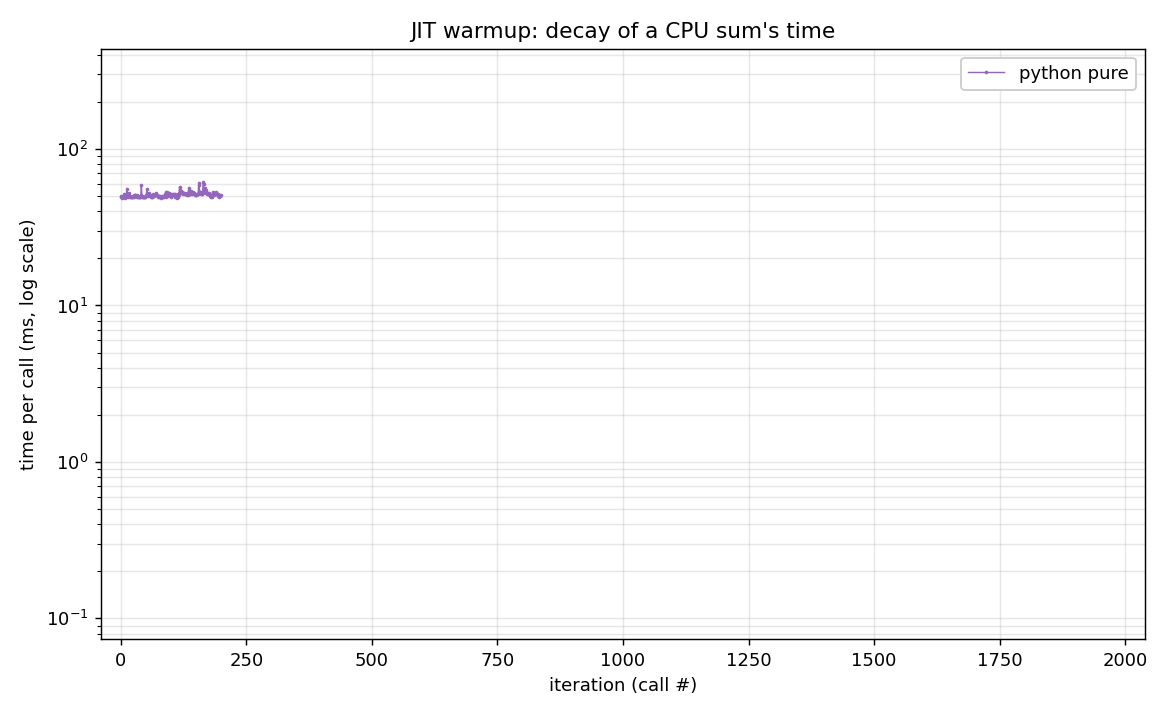
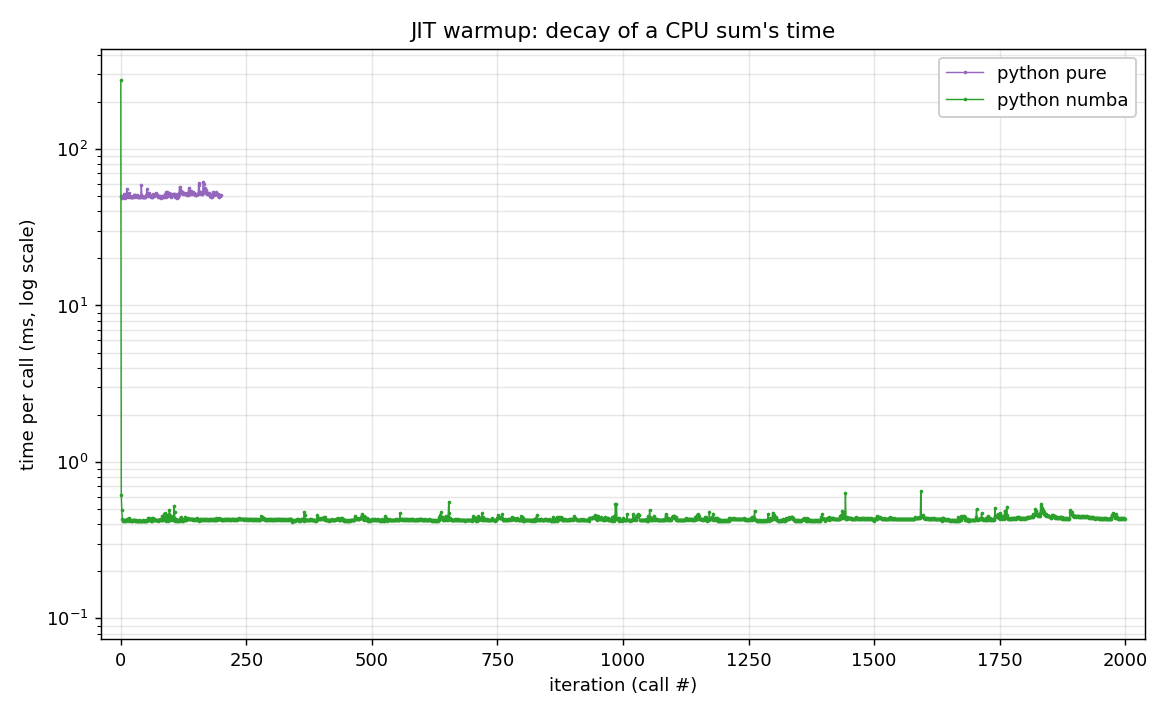
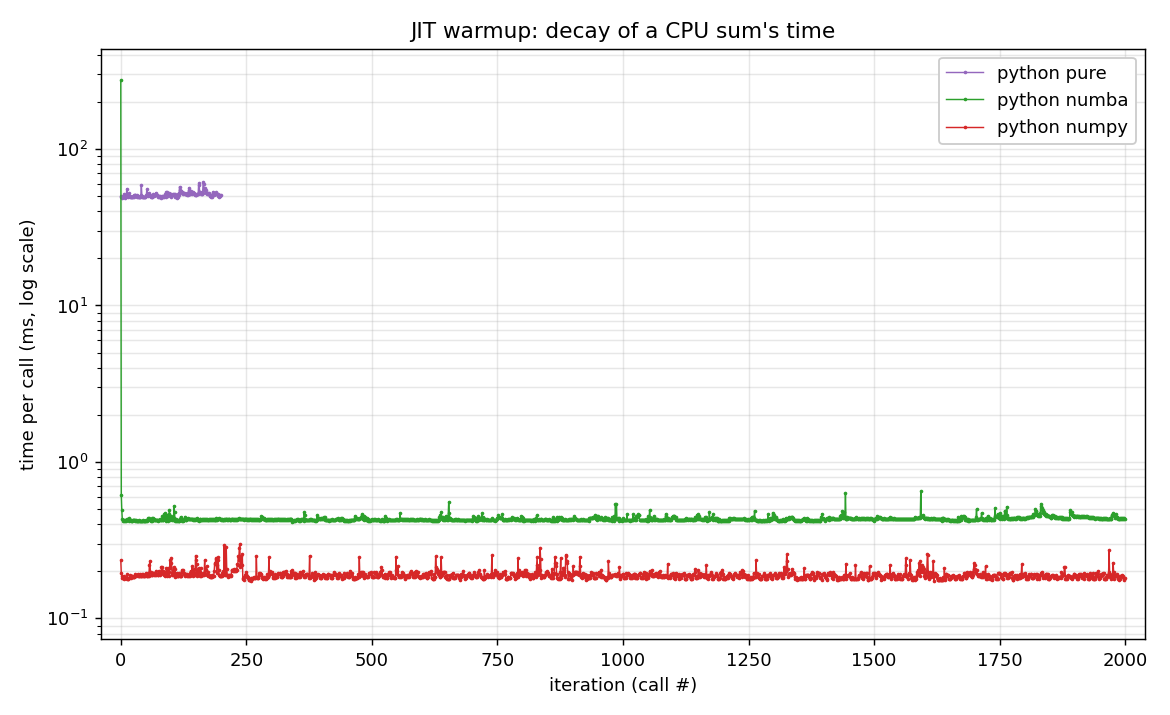
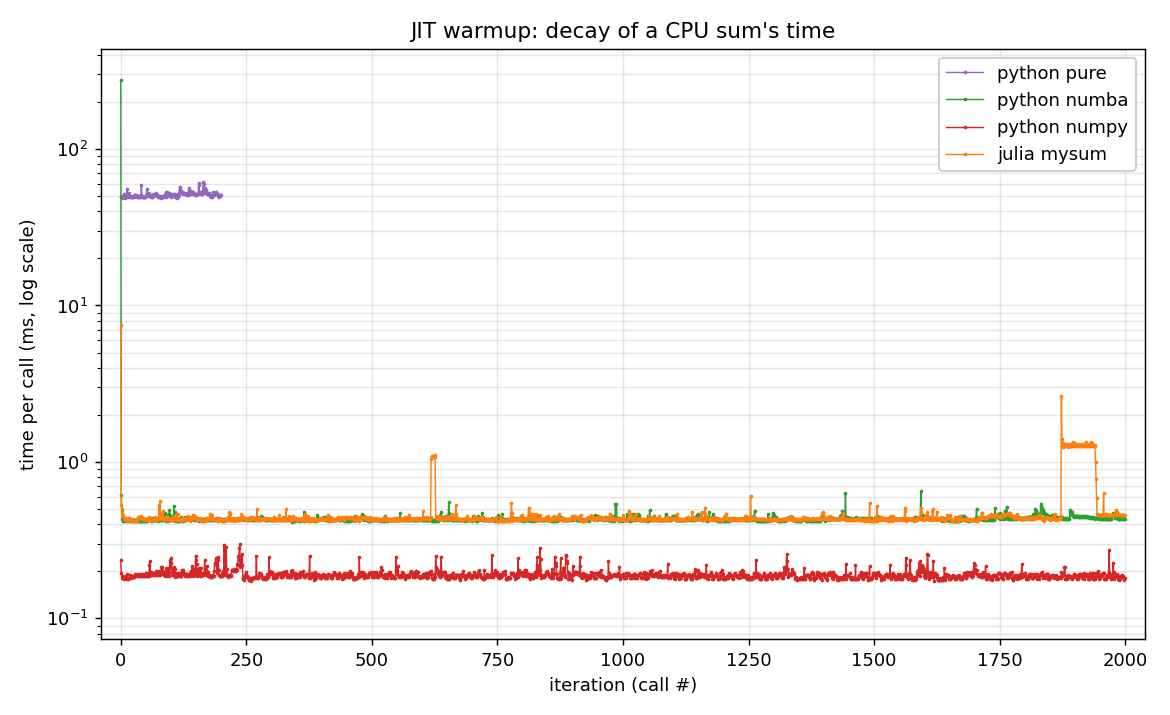
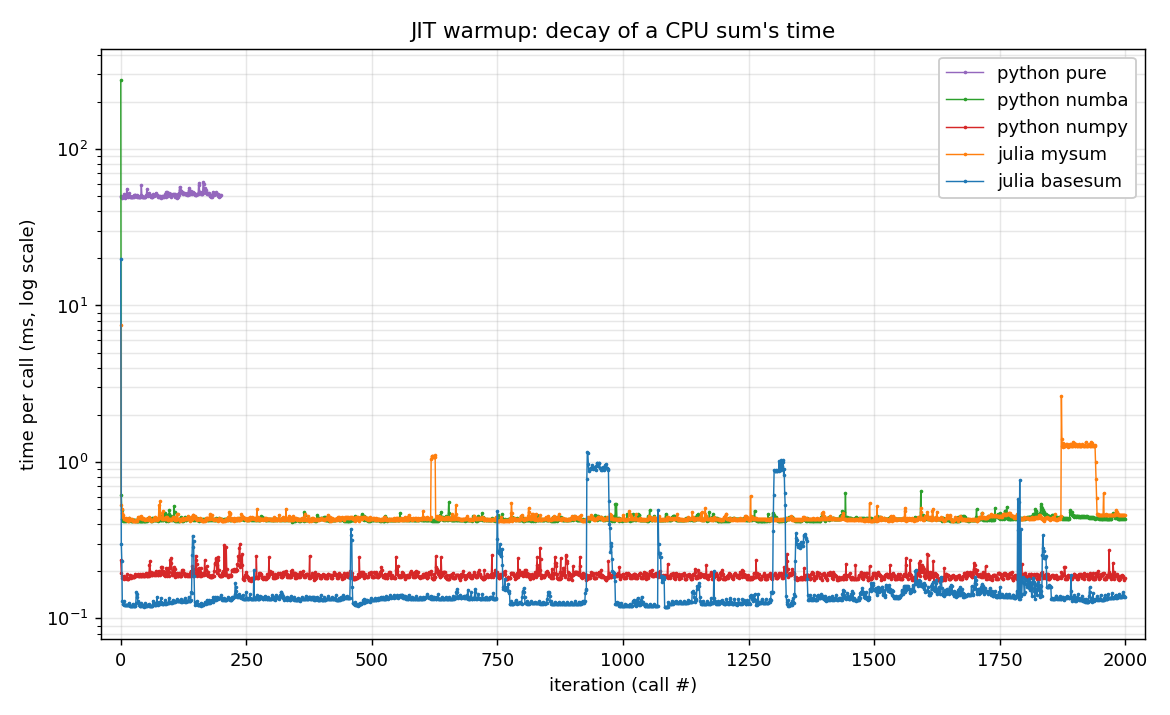
Reading the curves
| variant | compile spike | plateau |
|---|---|---|
| pure Python | 0 — never compiled | ~50 ms |
numba @njit |
~340 ms | ~0.4 ms |
| numpy | ≈ 0 — precompiled C | ~0.2 ms |
Julia mysum |
~7 ms | ~0.4 ms |
Julia sum |
~20 ms | ~0.1 ms |
The spike is the JIT compiling — paid once, then amortized. Pure Python has no spike, but its plateau stays slow (never compiled).
What the warmup reveals
- The spike = just-in-time (JIT) compilation on the 1st call, for that argument type.
- Everything is JIT in Julia: even Base
sum(re)compiles per type on first use. - numpy = ahead-of-time C → fast, no warmup; pure Python = never compiled → slow, no spike.
Note
Type checked at run time, every operation, on boxed objects (pure Python) = slow; type known at compile time, check eliminated (numba/Julia) = specialized native code = fast… once the warmup is paid.
What is JIT?
Three ways to get from source code to the processor:
- Interpreted (CPython): the bytecode is re-examined at every operation → slow, but starts instantly.
- Ahead-of-time / AOT (C,
numpy): everything compiled before execution → fast, zero warmup. - Just-in-time / JIT (Julia): compiled on the 1st execution, then native → fast after the warmup.
The spike we just saw is exactly the JIT compiling.
Julia: one native version per type
JIT gives native speed — but there’s a catch: the machine code must be specialized. There is no single “x + y” instruction.
The same x + y becomes different assembly depending on the argument types:
x, y |
machine code for x + y |
|---|---|
Int, Int |
add (integer) |
Float64, Float64 |
vaddsd (float) |
Float64, Int |
vcvtsi2sd + vaddsd (convert, then add) |
Julia’s solution: on the 1st call, compile a native version specialized for the concrete types, then reuse it. Type known at compile time → the check/conversion vanishes from the hot code (≈ C).
Picking the version from the type of all arguments = multiple dispatch (covered in the dispatch module).
The pitfall: type instability
- Untyped global variable → dynamic code, comparable to Python.
- The tool:
@code_warntype(red =Any). - Golden rule: put the work in functions that receive their data as arguments.
Measuring properly
- Pitfall A: timing the compilation instead of the computation — exactly the warmup spike we just saw.
- Pitfall B: measuring only once →
@btime/@benchmark.
Always discard the 1st call (warmup), then measure the steady state.
Code introspection
Opening the box
- Julia lets you inspect what it generates, at every stage of the pipeline:
We saw Base
sum≈ 5× faster thanmysum(same computation).@code_nativetells us why.
Why sum beats mysum — 1/2
@code_native mysum — the hot loop:
vaddSD= Scalar Double = 1 float at a time, a single accumulatorxmm0. → scalar.- Each
+waits for the previous one → a single dependency chain (latency-bound).
Why sum beats mysum — 2/2
@code_native sum shows that for N ≥ 16 the work is not inlined:
Inside mapreduce_impl:
vaddPD= Packed Double = 4 floats at once → SIMD 4-wide.- 4 independent accumulators
ymm0..ymm3→ 16 doubles / iteration, 4 parallel chains (ILP).
The catch: associativity
Warning
Floating-point addition is not associative: (a+b)+c ≠ a+(b+c) (rounding). Without permission, the compiler must keep the order → mysum stays scalar and serial.
sumgoes through a reduction that allows reassociation (+ pairwise in blocks of 1024) → the compiler can vectorize and parallelize.
Confirmation: @simd
A single word lifts the catch — we explicitly allow reassociation:
| variant | time / call |
|---|---|
mysum (scalar) |
42 µs |
mysum_simd (vaddpd ymm) |
4 µs |
Base sum |
8 µs |
It’s not “Julia magic”: what we see is the algorithm (allowed reassociation → SIMD + ILP), not the language.
Going further
- ▶ Notebook (demo + solution): Interpreted vs compiled
- 🔬 The JIT warmup:
experiences/warmup_jit/(warmup.py,warmup.jl). - 🔬 The
mysumvssumasm + the@simdcounter-test:experiences/sum_vs_size/reflection.jl.
⬅ Previous: 0 — Julia for Python users · Next: 2 — Multiple dispatch vs OOP ➡